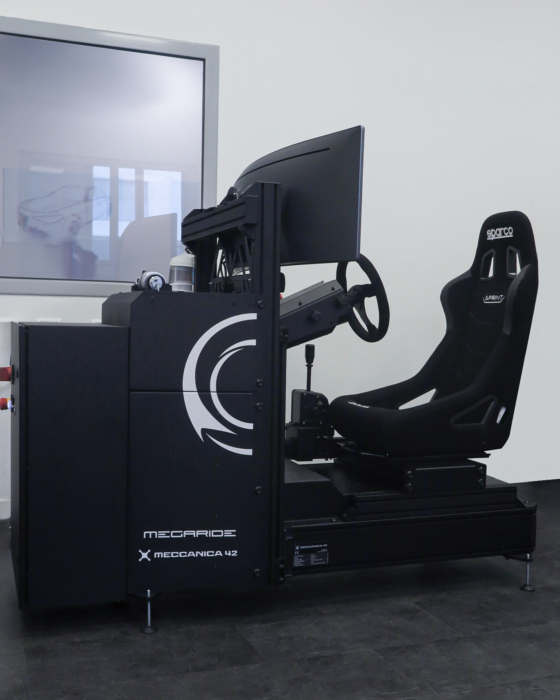
Vehicle dynamics assessment of tire setup variations in DiL for MegaRide R&D activities
In tire modelling and validation, parameter changes are defined and quantifiable. Their engineering relevance, however, emerges especially when they translate into steering torque and braking feedback perceived by the driver.
Track testing remains essential for final validation. Comparative assessments across multiple variants, vehicles and operating conditions, however, demand repeatability and controllability that physical testing alone cannot ensure.
In this context, MegaRide identified the need for a structured tool to assess the impact of tire setup variations on vehicle dynamics and driver perception and entrusted Meccanica 42 with its implementation.
To address this requirement, we developed a Driver-in-the-Loop (DiL) architecture capable of converting tire model outputs into physically consistent steering and braking feedback within a controlled and repeatable environment.
System architecture: active feedback systems
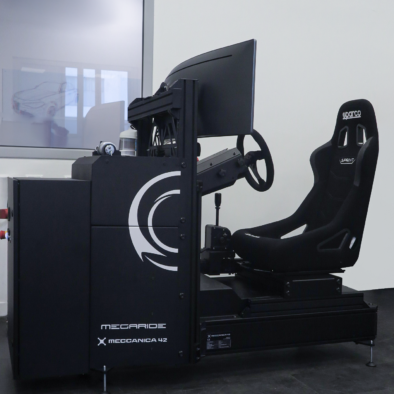
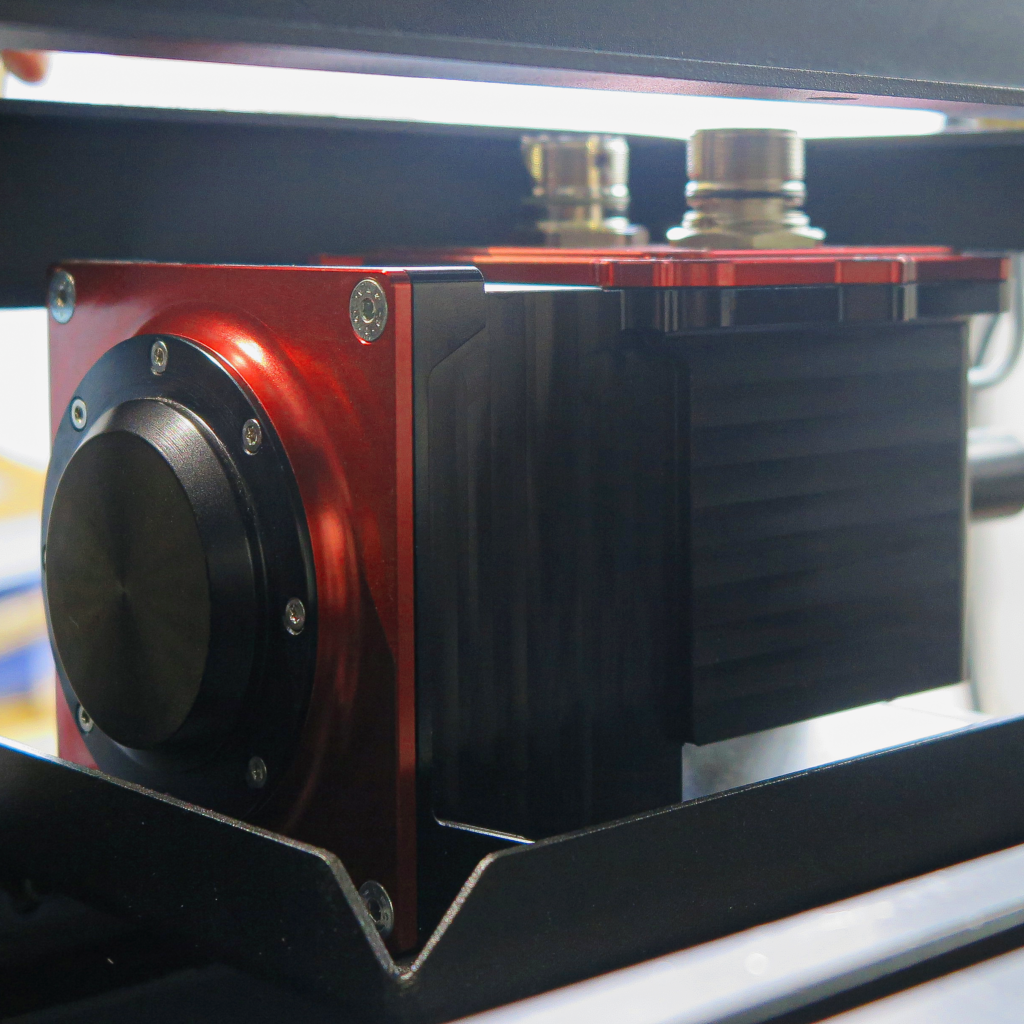
The system consists of a fully integrated cockpit equipped with active Steering and Brake Feedback Units, entirely designed and engineered in-house.
It operates through a real-time closed loop:
- the driver applies steering angle and brake pedal input
- the simulation platform computes vehicle and tire dynamics
- steering torque and brake force commands are transmitted to the Feedback Units
- the driver receives the corresponding physical response.
Rendering simulation outputs into credible physical feedback is a precision-critical task. Drivers detect minimal torque irregularities, non-linear gradients, parasitic friction and temporal inconsistencies. Even small mechanical imperfections affect perceived realism and compromise evaluation reliability.
For this reason, the Feedback Units were engineered to deliver accurate torque and force actuation, stable real-time communication and consistent dynamic performance. The validity of the driver-in-the-loop process depends on strict coherence between model output and physical actuation output.
Both steering and braking profiles are software-defined, enabling rapid parameters changes without hardware intervention.
Limitations of passive feedback systems
Conventional simulator architectures often rely on passive or mechanically adjustable feedback systems.
In such configurations:
- steering torque profiles are constrained by hardware characteristics
- brake pedal force curves require mechanical modification
- setup time increases with each configuration change.
During tire parameter sweeps, this rigidity becomes a limiting factor. Engineers require immediate adaptation of feedback laws to evaluate successive variants efficiently.
The constraint does not lie in the simulation model itself, but in the ability to reproduce its outputs as precise and tunable physical outputs.
Active Steering Feedback Unit (ASF)
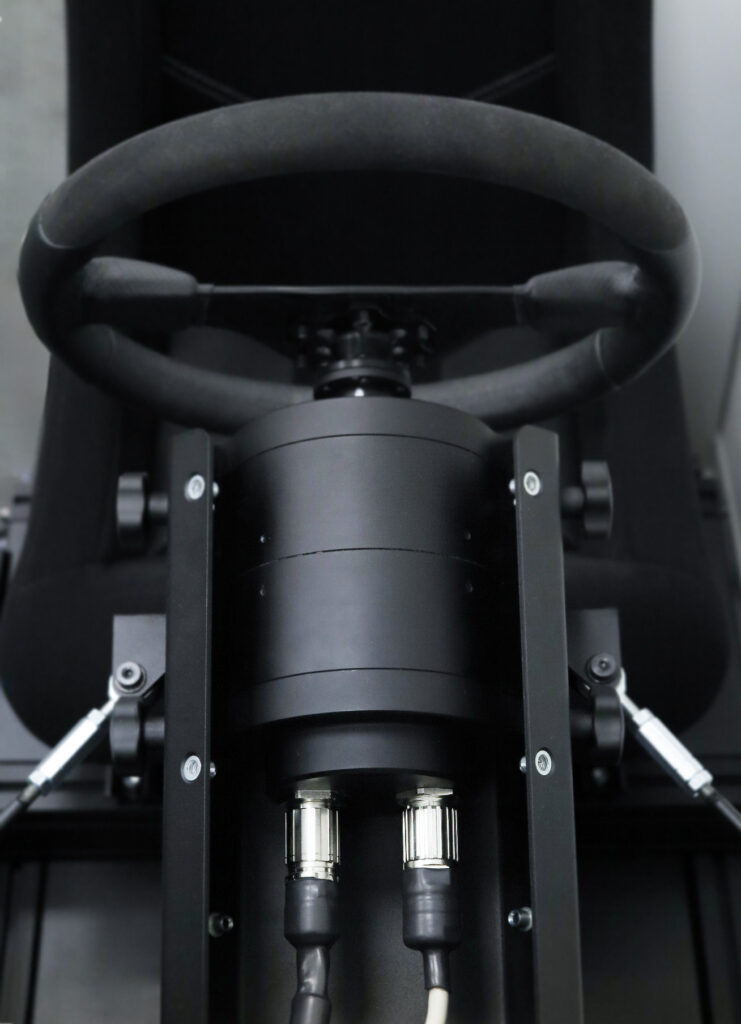
The ASF measures steering angle and actuates torque in real time according to the simulation output.
Its torque range covers both road applications and high-performance use cases. The steering assembly is adjustable, and different steering wheels can be installed to match application requirements.
Torque actuation logic is defined via software. Engineers can modify torque mapping functions and directly evaluate how tire parameter variations influence on-center steering gradient, stability and controllability.
The actuation fidelity ensures that perceived differences reflect model variations rather than hardware artifacts.
Active Braking Feedback Unit (ABF)
The ABF enables software-defined pedal force–position mapping.
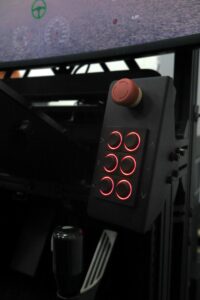
Within this project, three predefined calibration curves were implemented and selectable through a dedicated HMI:
- soft force-travel curve, representative of lightweight vehicles
- intermediate force-travel curve
- high-stiffness force-travel curve, typical of high-performance applications.
The unit measures pedal position and transmits it to the simulation platform. Force feedback follows the selected curve in real time.
In addition to predefined presets, the architecture supports custom pedal characteristics to replicate existing systems or evaluate target brake feel profiles.
Compared to mechanically adjusted solutions, this configuration supports rapid comparative assessments and structured evaluation of longitudinal vehicle dynamics across different tire setups.
Impact of active feedback systems on tire development
Integrating active steering and braking feedback into the simulation loop enables the client to:
- evaluate multiple tire variants across different vehicle setups
- perform controlled A/B comparisons under repeatable conditions
- isolate the contribution of tire parameters to steering and braking perception
- reduce reliance on early-stage track sessions
- allocate testing resources more efficiently before physical validation.
Development iterations can be filtered and converged within a controlled environment before on-road confirmation.
For R&D activities evolving from tire modelling toward broader vehicle dynamics and Driver-in-the-Loop applications, this architecture provides a technically consistent and scalable foundation.
For more information about our innovative solutions and how they can streamline your vehicle’s functions development, please contact us.
Don’t forget to follow us on LinkedIn, Instagram, and to subscribe to our newsletter to stay in the loop!